What is muscle strengthening exercise?

Muscle strengthening exercises are activities that make your muscles work harder than usual, helping them become stronger. This can help make daily tasks easier! 

There are many ways to perform muscle strengthening exercises, including using your body weight, resistance bands and dumbbells!

Muscle strengthening guidelines for cancer survivors

Cancer survivors are recommended to achieve 150 minutes of moderate intensity aerobic activity, as well as two days of muscle strengthening exercises of all major muscle groups each week1. 

STRIVE Cardio muscle strengthening exercises

For this program, we ask that you complete eight muscle strengthening exercises. This will target all major muscle groups of your body. These exercises are listed below. 

You should try your best to complete all of these exercises in each of your muscle strengthening sessions. This may take ~40 minutes when you begin, but you will likely complete these exercises faster as you continue to practice! 
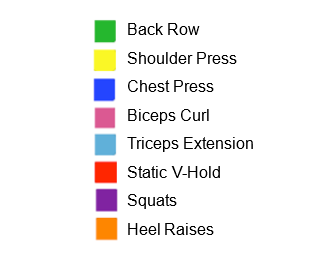
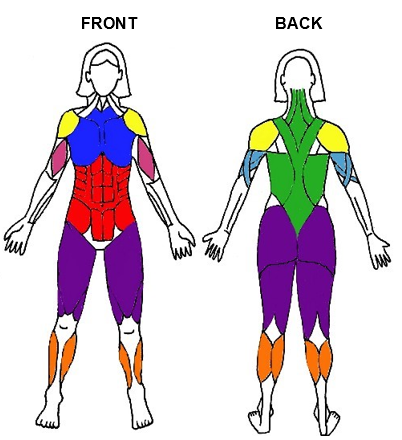
Color key for muscle group visual aid
Visual aid highlighting all major muscle groups

Using good form

It is very important to use good form with every exercise. The study team is here to help you learn the correct movements and modifications with each exercise!

Good form means: 
1. Using the muscles the exercise is supposed to use 
2. Doing the exercises safely, decreasing the risk of pain or injury

Be sure to go through the videos and photos of each exercise below. Your health coach will be happy to answer any questions and help you learn how to correctly do all of the exercises!

Style points to remember

Listen to your body and do what feels right for you. You will have days when you can do more and days when you need to do less - THAT IS OKAY! 

Use slow and steady movements. 

DON'T HOLD YOUR BREATH! Holding your breath while straining can cause changes in your blood pressure. Remember to breathe normally with each exercise. Generally, it is a good rule of thumb to exhale during the hardest part of the exercise, and inhale during relaxation. 

Remember, everyone has their own pace and it is okay to rest between repetitions or different exercises. YOU CAN DO THIS! 

SAFETY REMINDERS

There should be no joint pain with these exercises. if you are experiencing pain, please bring this up during your health coaching sessions, or you may call us to discuss your discomfort. 

Exercises should be postponed if you fall ill or have a new injury. Contact your doctor if you experience: 

Dizziness 
Nausea
Chest pain/pressure
shortness of breath 

Logging the exercises

Be sure to complete all of your exercise logs to get credit for you hard work! These logs will help you and the research team track your progress and adherence to the program. You may complete these logs on the paper logs included in your participant binder or electronically using the logs emailed to you by the research team. 

Please record the equipment you used, the weight you were using (such as the color of resistance band or weight of dumbbells, if applicable), the number of repetitions you completed, and your rating of perceived exertion for each set of each exercise. 

It is best practice to record as you go, or immediately once you are done with a session. This way you are les likely to forget how you felt, how many sets you completed, or what resistance you were using. If you chose to use any of the paper exercise logs, please keep it safe in your participant binder and bring them with you to your final study visit. 

Guidelines for advancing the exercises

By continuing to advance the exercises in this program you can keep improving and gaining strength. By making these exercises challenging to you, you will continue to benefit! 

As your strength improves, the exercises will naturally become easier. Once an exercise feels too easy, use one of the recommended progressions to increase the difficulty. 

General guide to increasing exercise difficulty: 

1. Increase the number of repetitions. You may increase the number of repetitions you are doing with the same weight, remembering to do no less than 8 but no more than 12 repetitions. 

2. Increase the weight. Once you have increased to 12 repetitions and this feels to easy, decrease the number of repetitions and increase the amount of weight you are using. 

3. Repeat the cycle. Gradually work up to 12 repetitions with the new heavier weight, once that becomes too easy again drop the number of repetitions and increase the amount of weight. 

Some days you may feel the exercises are too hard, that's okay too! When this happens, use the recommended regressions for the exercises. 

General guide to decreasing exercise difficulty:

1. Decrease the number of repetitions. Continue using the same weight with less repetitions, but remember to perform no less than 8.

2. Decrease the weight. If the weight you are using is too difficult at the minimum number of repetitions (8), perform the exercise using a lighter amount of weight. 

3. Try the exercise seated. This is not applicable to all exercises, but some of the exercises may be easier to perform in a seated position rather than standing.

The recommended progressions and regressions for each exercise can be found in your participant binder OR in the video and photo modules above. 

References

1. Campbell, K. L., Winters-Stone, K. M., Wiskemann, J., May, A. M., Schwartz, A. L., Courneya, K. S., Zucker, D. S., Matthews, C. E., Ligibel, J. A., Gerber, L. H., Morris, G. S., Patel, A. V., Hue, T. F., Perna, F. M., & Schmitz, K. H. (2019). Exercise Guidelines for Cancer Survivors: Consensus Statement from International Multidisciplinary Roundtable. Medicine and science in sports and exercise, 51(11), 2375–2390. https://doi.org/10.1249/MSS.0000000000002116